
Dhaka Test, Day 3: Naeem Hasan's 200-Run Hope and Bangladesh's Fragile 106-Run Lead
ढाका टेस्ट के तीसरे दिन के खेल तक बांग्लादेश ने दूसरी पारी में छह विकेट पर 79 रन बनाए थे। पहली पारी की 27 रन की बढ़त जोड़कर उसकी कुल बढ़त 106 रन हो गई, हाथ में चार विकेट बाकी हैं और दो दिन का खेल शेष है। सातवें विकेट पर नईम हसन और जेकर अली की साझेदारी टिकी हुई है। नईम हसन ने खेल के बाद कहा कि वेस्टइंडीज़ के सामने 200 रन का लक्ष्य रखना बहुत अच्छा रहेगा — यह एक खिलाड़ी की इच्छा है, टीम का तयशुदा लक्ष्य नहीं। 200 तक पहुँचने के लिए बांग्लादेश को आखिरी चार विकेटों से 94 रन और चाहिए, इसलिए सबसे संभावित लक्ष्य 150-190 के बीच माना जा रहा है; अगर पूँछ जल्दी गिरी तो यह 150 से नीचे भी रह सकता है। इस मैच की असली चिंता 200 का आंकड़ा नहीं, बल्कि घरेलू पिच पर वेस्टइंडीज़ के स्पिनरों के सामने टॉप ऑर्डर का 79/6 पर सिमटना है। नईम हसन मूल रूप से गेंदबाज़ हैं जिनकी बल्लेबाज़ी बोनस है, और चौथी पारी में उन पर दोहरे वर्कलोड का जोखिम है। वेस्टइंडीज़ ने गेंदबाज़ी का अंतर जीता है, फिर भी 106 रन पीछे है — यानी स्कोरबोर्ड से मैच ज़्यादा करीब है। दो दिन बाकी होने के कारण केवल बारिश ही ड्रॉ का रास्ता है।
Dhaka: Day 3 of the Dhaka Test gave Bangladesh two different stories at once — a position that looks strong on the scoreboard, and a batting effort that does not support it. By stumps Bangladesh had reached 79 for 6 in their second innings. Added to the 27-run first-innings lead, that made a total advantage of 106 runs, with four wickets in hand and two full days of play remaining.
There are two ways to read that score. The first is that the home side is in a strong position, because in Test cricket a fourth-innings target above 150 on a turning subcontinental surface is never comfortable. The second is that the position was not built — it was inherited. West Indies' low first-innings total handed Bangladesh a 27-run cushion, and after that Bangladesh's top and middle order fell away in a sequence against West Indies' spin. The seventh-wicket stand between Naeem Hasan and Jaker Ali is now the last line of genuine resistance, and it is that partnership which is giving the team hope.
Speaking to reporters after play, Naeem Hasan said it would be very good if his side could set West Indies a target of 200. By the next news cycle, that had been reported as Bangladesh's plan. Cricketing logic says otherwise. A player's hope and a team's tactical plan are not the same thing. When a batter at the crease says 200 would be nice, he is describing a ceiling, not making a forecast.
The arithmetic is simple. Bangladesh lead by 106 with four wickets left. Reaching 200 requires 94 more runs from those four wickets. That number does not sound large, but those 94 runs have to come from the part of the order that is selected for bowling, not for run-making.
So 200 should be treated as an upper bound, not a central projection. The more probable band is 150 to 190. And if the overnight pair is broken inside the first hour and the tail follows quickly, Bangladesh could fold below 150 — in which case the target lands between 130 and 150 and the match is wide open.
The real story, therefore, is not in Naeem's 200. It is in what a 79 for 6 collapse in a home side's own second innings signals about its top order. That is the most important data point of this match, and a Bangladesh win will bury it completely behind a 106-run lead.
There is no specific strategy in what Naeem said about batting. His words were that the more runs they score the better; that they will try to make the innings as long as possible; and that he tries to do whatever the team needs. All of that is correct, safe and team-first — but none of it mentions targeting a particular bowler, batting to a particular over count, or a declaration window. Extracting a firm tactical plan from those lines is not possible.
The most loaded remark was that everyone has to bat. In cricket terms that is a major signal. It means the recognised batters are already gone and the outcome now rests on the tail. That is a fragility marker, not a resilience marker. A team whose runs are coming from number eight does not have unexpected depth; it has a top-order problem.
It is also worth noting that the senior partner in the stand that decides this match is Jaker Ali, and he has barely been mentioned. The stand's durability depends on him more than on Naeem, because he is a specialist batter and the longer innings is expected of him.
Naeem describes his own role plainly: when he has the ball he is a bowler, when he has the bat he is a batter. That is the classic definition of a bowling-first all-rounder, whose batting is a bonus rather than a load-bearing function. He was excellent with the ball in West Indies' innings, the most effective bowler on show. But that also means his workload has now doubled — a full innings of bowling, an extended batting stint, and then very probably a decisive fourth-innings spell.
That is a workload-management question the coverage has not addressed. For a frontline spinner in subcontinental heat it is a legitimate route to fatigue and reduced output. If his spells shorten on Day 4, or the revs and pace drop, that should be read as a workload signal, not a form signal.
Now the other side of the match. Spin against a West Indies line-up that has historically struggled on the subcontinent is Bangladesh's structural edge. Here the reverse is happening: it is West Indies' spinners who are breaking Bangladesh's top order. That is the single most unusual data point of the match. West Indies have historically been the most spin-vulnerable of the major sides in Asia, and yet their spinners are now the biggest contributors towards a win.
That carries a further conclusion worth remembering — better process and a better scoreboard do not always travel together. On the balance of play, West Indies have clearly won the second-innings bowling exchange and still trail by 106. That usually means the match is closer than the scorecard suggests. Bangladesh's lead is a 27-run first-innings margin plus 79 runs so far — and a 27-run differential sits comfortably inside normal innings-to-innings variance. It should not be read as evidence of superiority.
The forward arithmetic: two days left, roughly 180 overs. Time is not the constraint on a result; only weather is. Bangladesh need not force the pace, but they cannot waste time either, because the surface will assist spin further on Days 4 and 5 and the chasing burden will grow for West Indies.
No official Dhaka forecast is part of this assessment. But it is clear that rain washing out a large part of Days 4 and 5 is the only route by which West Indies escape without a result. It is the unmanaged variable and should be logged as the biggest risk.
The points-table context matters too. If this match sits inside the World Test Championship cycle — as almost every bilateral Test since 2026 has — the result carries value beyond the series scoreline. A low-revenue fixture like this derives its real significance from WTC points.
There is one governance-adjacent variable: over rate. Slow over rates are routine in spin-heavy subcontinental Tests, and a shortfall can trigger WTC points deductions. That is a forward risk, not an observed event.
The risk list begins with the second-innings collapse extending into a sub-150 total. Second is single-bowler dependency — the bowling praise here went essentially to one man, and if he is neutralised the attack has no obvious second angle. Third, bench depth cannot be assessed because no squad or selection information is available. Fourth, weather. Fifth, home-crowd frustration and the pressure that would fall on the captain and selectors if a winning position is surrendered.
One necessary caveat. The material underlying this report carries no outlet name, byline or date. The currency and reliability of the numbers therefore cannot be treated as verified. The arithmetic is internally consistent — 27 plus 79 makes 106 — but the scoreline should be confirmed against a primary scorecard before any conclusion is acted upon.
In media terms, Naeem Hasan may emerge from this one innings looking bigger than his career output warrants; that is a small-sample effect. His identity is as a bowler, and this day reinforces that rather than changing it. Any emerging all-rounder narrative needs a multi-match sample across home and away conditions first.
As for West Indies, they have done the thing they were least expected to do — win with spin on the subcontinent. If their batting gets a chase in the 150-to-170 range on the final day, this match is genuinely open. The gap between what the scoreboard says and what the cricket shows is the most interesting part of the contest.
The conclusion is that Bangladesh hold a strong position but not a strong process. Their collapse, and their reliance on a bowling all-rounder for runs, is the real story of this match — not the 200. The first hour of Day 4 will decide whether that story is remembered alongside a win or alongside a question.
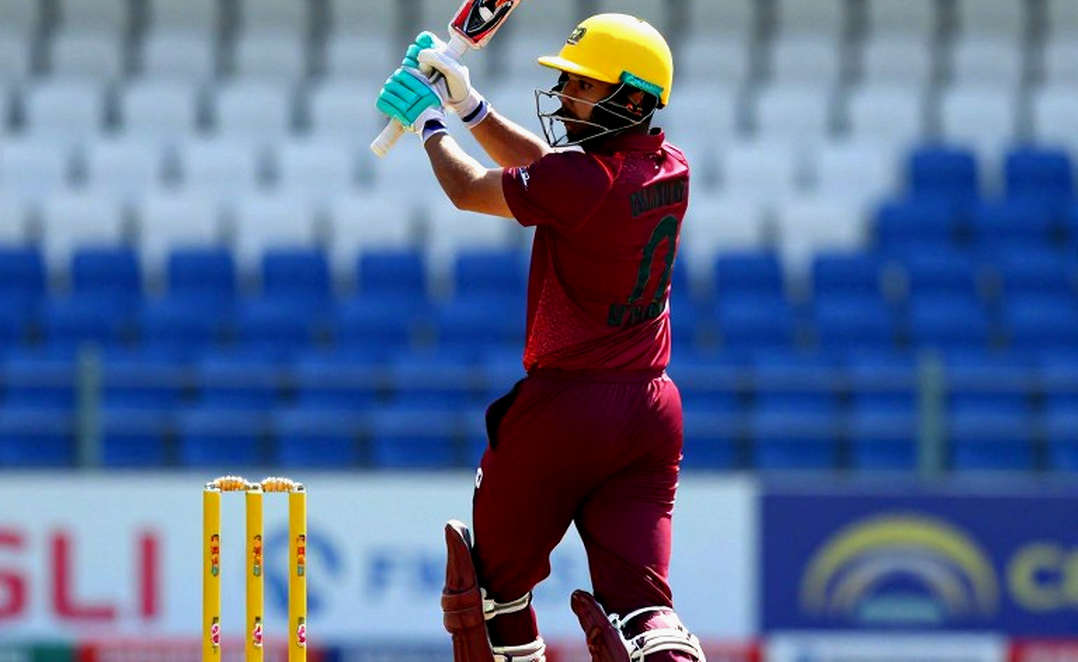


संबंधित खिलाड़ी
अनुशंसित
Pakistan's Test Squad: Three Debutants, Two Recalls, and the Gap the Scorecard Won't Show2026-10-30
The December Fitness Test: What MS Dhoni’s IPL 2027 Call Really Means for CSK’s Retention Calendar2026-10-29
Aliss Al Islam's Bowling Action Test in Chennai: Bangladesh's Process Question Beyond the Defeat2026-10-29
Padikkal's 199, India A's 313-run lead and fading light: first unofficial Test ends in draw2026-10-28
A Full Ground on an Empty Sheet: Asian Cricket's Missing Record2026-10-31
Asia Cup is hope, 2028 World Cup is target: Fahim Sinha's roadmap for Bangladesh Under-192026-11-02
Two Draws, One Headline and an Empty Column: The Rush to Question Rajasthan's Selection2026-10-27
अनुशंसित
A Full Ground on an Empty Sheet: Asian Cricket's Missing Record2026-10-31
'Contrary to the Spirit of the Game': Haris Rauf's Five Demerit Points and the Part of Pakistan's One-Wicket Win the Scorecard Won't Show2026-10-29
The News of the Empty Scorecard: When Cricket's Data Pipeline Goes Silent2026-10-31
{{English headline, same facts}}2026-10-31
Aliss Al Islam's Bowling Action Test in Chennai: Bangladesh's Process Question Beyond the Defeat2026-10-29
259 Overs and 3 Balls: India's First Women's Test of 2026, Where the Result Sat Three Wickets Away2026-10-31
Tri-Nation Final: Afghanistan's Trophy, Rashid's Rhythm, and Zimbabwe's 39 Balls That Were Never Bowled2026-10-25