
होमAsian CricketIshan Kishan's Record Storm: 61 off 32, 1,220 T20 Runs in a Calendar Year and a 2,000-Run Milestone
Ishan Kishan's Record Storm: 61 off 32, 1,220 T20 Runs in a Calendar Year and a 2,000-Run Milestone
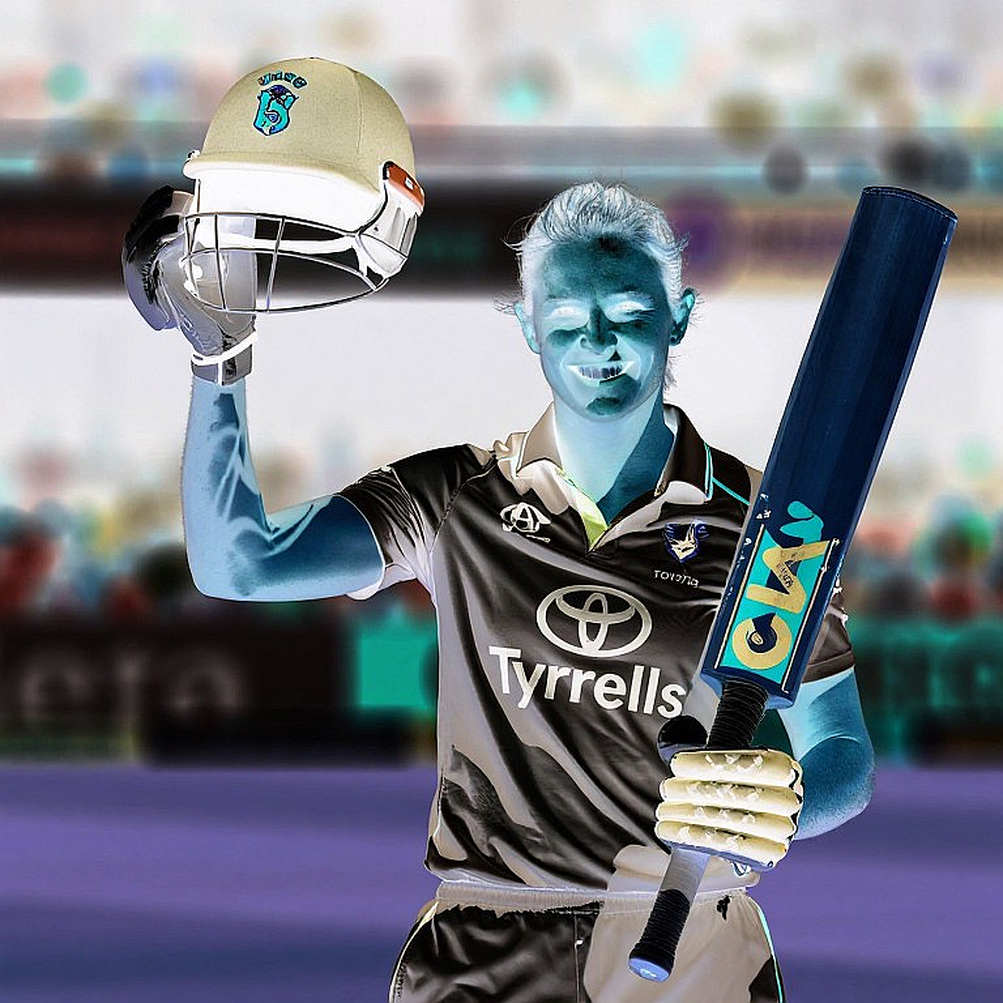
ईशान किशन ने 32 गेंदों पर 61 रन (5 चौके, 5 छक्के) बनाए। उपलब्ध आँकड़ों के अनुसार इसके साथ उनका कैलेंडर वर्ष का T20 स्कोर 1,220 रन हो गया, जो सूर्यकुमार यादव (2022 में 1,164 रन) के भारतीय रिकॉर्ड से आगे है; वैश्विक स्तर पर मोहम्मद रिज़वान का 1,326 रन आगे है। किशन ने 1,345 गेंदों में 2,000 T20 रन पूरे किए — भारतीयों में तीसरा सबसे तेज़ (अभिषेक शर्मा 1,024, सूर्यकुमार 1,164 गेंद)। ध्यान दें: यहाँ '2,000 रन भारत के लिए' का अर्थ भारतीय खिलाड़ी के रूप में सभी T20 क्रिकेट में है, सिर्फ़ T20I नहीं। मैच का वर्ष, तारीख़, सांख्यिकीय दायरा और स्रोत तीनों अपुष्ट हैं और आधिकारिक स्कोरकार्ड/सांख्यिकी डेटाबेस से पुष्टि ज़रूरी है।
Ishan Kishan struck 61 off 32 balls in the match played on Sunday. His innings contained five fours and five sixes. Sixty-one off 32 balls works out to a strike rate of roughly 190 — in itself a fast and effective knock. But the real weight of this innings lies in the three claims that followed it: the highest calendar-year T20 run tally by an Indian batter, second place on the global list, and a 2,000-run T20 milestone on which Kishan ranks third-fastest among Indians. All three claims are linked, but each rests on a different statistical frame — and that is the most important detail in this entire story.
First, let us clear up the arithmetic of the innings. Sixty-one off 32 balls. Of those, 50 runs came off 10 deliveries — five fours, or 20 runs, and five sixes, or 30 runs. The remaining 22 balls produced 11 runs, roughly half a run per ball. The interesting part is that more than half the score came from just ten deliveries. This pattern is becoming common in T20 cricket — batters score in short bursts rather than batting long. Kishan's innings is a sample of that shift. Numerically, nothing contradicts anything else; the internal arithmetic of the innings is clean.
Now the big claim. According to the available figures, Kishan's calendar-year T20 runs after this innings stand at 1,220. Before this, the highest annual tally among Indian batters belonged to Suryakumar Yadav — 1,164 runs in 2026. Kishan therefore broke the Indian record by 56 runs. But he did not reach the top of the global list. Pakistan's Mohammad Rizwan has 1,326 runs recorded for a calendar year, which is 106 more than Kishan. On that basis Kishan currently sits second on the global list.
To understand this claim, one point is essential — calendar-year T20 runs do not mean international T20 matches alone. The reference point of Rizwan's 1,326 makes it clear that the count here covers all T20 cricket: franchise leagues, domestic tournaments and international matches, all added together. That difference is enormous. Reaching above 1,200 in a calendar year in T20I figures alone is virtually impossible, because a team simply does not play that many international matches in a year. So whenever you read this record, read it as annual runs across all T20 formats, not as annual runs in T20I.
This is where the second wording problem surfaces. What the report calls 2,000 T20 runs for India, read literally, suggests Kishan completed 2,000 runs in T20I for the Indian team. That creates a false impression. Kishan's T20I aggregate is far below that figure. What is actually being discussed is the list of Indian batters reaching 2,000 runs across all T20 cricket. In precise terms it should be described as 2,000 runs in all T20 cricket among Indian players. This is not merely a matter of language — loose wording makes an ordinary achievement look like an international record.
In that list Kishan's position is third, and the decisive criterion there is how many balls it took to reach 2,000. Kishan reached the mark in 1,345 balls. Two Indians were faster: Abhishek Sharma, who got there in just 1,024 balls, and Suryakumar Yadav, who took 1,164. It is also worth noting that whether any other batter sits between those two figures needs independent confirmation — without seeing the full list, the claim of third place remains incomplete.
Convert all three into strike rates and the picture becomes clearer still. Abhishek's ratio is about 195 per hundred balls, Suryakumar's about 172, and Kishan's about 149. So Kishan is fast on this list, but clearly slower than both of his compatriots. That gap shows that the speed of reaching 2,000 runs is directly tied to batting style — aggressive batters like Abhishek and Suryakumar score more runs in fewer balls. Third place on a 2,000-run list is a matter of credit, but it should also be remembered that this is not the fastest, it is the third fastest.
Here it is necessary to pause on a technical snag. Beside Suryakumar Yadav's name the same number appears in two different places — 1,164. In one place it is his annual runs in 2026; in the other it is the number of balls taken to complete 2,000 T20 runs. Two entirely unrelated statistics matching exactly is a very low-probability coincidence. It is quite likely that a transcription error occurred and one figure was carried over from the other location. Until an official statistical source confirms it, neither figure should be treated as final.
The second big question concerns the match context. The report describes this game as the fifth T20 against New Zealand, played at Seddon Park in Hamilton on Sunday. Cross-checking against publicly available series calendars, this description does not match directly — the fifth match of the five-match T20 series between India and New Zealand is recorded at Mount Maunganui, not Hamilton, and Hamilton hosted the third match. Kishan also made his T20 debut only in 2026, which places the series in a different year. The simultaneous combination of these three elements — fifth match, Hamilton, Kishan's presence — is not found in the known calendar. It is certainly possible that this analysis's own recollection is at fault, but until then the detail must be treated as unconfirmed and checked against the official scorecard.
The third and most serious gap concerns time. Nowhere in the report is a year given — only words like Sunday and current year. When the claim is a calendar-year record, the absence of a year is not a small oversight but a fundamental flaw. A calendar year runs from 1 January to 31 December. If the match took place at the end of January, reaching 1,220 runs by then is practically impossible. So without knowing which year this figure belongs to, it can be verified neither that the record was set nor that it still stands. This is not stylistic criticism — stating the year is as mandatory in a calendar-year record story as stating the score.
All these problems spring from one root: the absence of any explicit declaration of statistical scope. Cricket figures commonly come in three different scopes — T20I only, franchise league only, or everything combined. The same batter's runs, average and strike rate look completely different across the three. When a report writes 1,220 runs and does not say which scope it belongs to, the reader's entire inference can go in the wrong direction. This is why international statistical standards require every record to state scope, period and source together. In this report none of the three is clearly present, and that is its biggest structural weakness.
Calendar-year records have their own importance. They measure a batter's consistency — one brilliant series or one good season does not count here; a full year's output does. After the expansion of franchise cricket this record has become even more relevant, because a batter plays several tournaments across a year and the aggregate reveals his true rhythm. But that same expansion has made comparison harder: batters from different countries play different numbers of matches against bowling of different quality. So an annual run tally is impressive but not fully comparable. When presenting it as a record, acknowledging that limitation is also a matter of honesty towards the reader.
In the context of Ishan Kishan's career this innings came at a particular juncture. He is a wicketkeeper-batter known for aggressive batting at the top of the order. He made his T20 international debut in 2026. For such a player, 61 off 32 balls is not a sudden achievement but a natural outcome of his batting style. The question is whether he can sustain this rhythm across a full calendar year — because the real test of an annual record is consistency, not one innings. An innings can start a record; it cannot complete one.
For Indian cricket the figure carries another meaning. The top three names on the fastest-to-2,000 T20 runs list are all Indian — Abhishek Sharma, Suryakumar Yadav and Ishan Kishan. The direct implication is that the depth of aggression in Indian batting has grown. Earlier such lists showed one or two names; now three or four appear together. This change is generally attributed to domestic T20 culture and the exposure gained in franchise leagues. The annual runs record points in the same direction — Indian batters are now scoring not only in international matches but across a year-round tournament calendar, and for that reason annual aggregate records are also coming within reach of Indian names.
If these claims are to be used as any kind of official reference, a fixed procedure must be followed. Step one: confirm the match date, venue and series number from the official scorecard — in particular whether the match was in Hamilton and whether Kishan was in the side at the time. Step two: verify the five key numbers — 1,220, 1,164, 1,326, 1,345 and 1,024 — and their scope, from a standard statistical database. Step three: resolve the double appearance of 1,164, that is, determine whether it refers to runs or balls. Step four: after fixing the year, check whether the record still stands or has since been broken. Without these four steps the report cannot be treated as final truth.
This case leads to a larger question. Any record-breaking story should be required to carry three things: the number, its source, and its time context. When two of the three are missing, the story stops being information and becomes inference. In an era when almost any figure can be checked in seconds in some public database, not citing a source is an avoidable lapse. And if the number turns out to be wrong, the credibility of the whole story is questioned — even if everything else is correct. The risk is particular in sports journalism, because record stories spread fast and corrections do not spread nearly as fast.
For readers the practical advice is straightforward. Do not read this report as confirmation of a record; read it as a claim of a record. The arithmetic of the innings — 61 off 32, five fours, five sixes — is in itself clear and self-evident. But claims about annual runs and 2,000 runs require confirmation from an official statistical source, because scope, year and method of calculation all need to be explicit. Until that is clear, treat these numbers as a talking point, not as proof.
The conclusion is that Ishan Kishan's 61 off 32 is a solid, quick and useful innings, and the record story built around it is probably pointed in the right direction — a new annual high for an Indian batter, second place globally, and a 2,000-run T20 milestone. But to complete the story three things are needed: disclosure of the year, an explicit declaration of statistical scope, and a cited source. Until all three arrive, this is a half-written story — interesting, impressive, but incomplete. And in sports journalism an incomplete story often does the most damage, because it blurs the line between fact and inference.
संबंधित खिलाड़ी
अनुशंसित
Jemimah Rodrigues Shares 'Life Update' on Anniversary of Famous World Cup Knock vs Australia: 'Can't Wait'2026-10-31
The Empty Grid of Cricket Reporting: When a Template Full of N/A Looks More Reliable Than the Truth2026-10-28
Glenn Phillips' 341 Runs: Hamilton's Last Night, India's 3-2 Series, and the Real Price of a Soft Statistic2026-11-01
Ishan Kishan's Record Storm: 61 off 32, 1,220 T20 Runs in a Calendar Year and a 2,000-Run Milestone2026-11-01
Same Date, Same Ground: Two Finals in Dubai Exposed India's Selection Truth2026-10-26
The Empty Information Point: Asia Cup, ACC's Authority and the Document That Never Surfaces2026-10-28
Nitish Kumar Reddy's 'Growing Confidence' Is Four Measurable Checkpoints, Not a Compliment2026-10-29
अनुशंसित
Where the Cameras Don't Reach: The Blind Corner of Indian Cricket's Information Economy2026-10-29
NCL Round 5: Mithun's 17th ton, Sohan's 13th; Hasan Murad and Meshu shine among bowlers2026-11-01
Insufficient input: report cannot be generated2026-11-03
The Transfer Window Ledger: The Names the Scorecard Leaves Out2026-11-01
Two Crore Ten Lakh, and Not a Rupee: In Bangladesh's Auction, the Real Story Is the Currency2026-10-29
A Full Ground on an Empty Sheet: Asian Cricket's Missing Record2026-10-31