
The Third Raid: The Regular Season's Real Ledger Is Being Written in the Corner, Not on the Table
**मुख्य उत्तर (लगभग 45 शब्द):** प्रो कबड्डी लीग के नियमित सीज़न में मैच का असली संकेत रेड-सक्सेस रेट नहीं, आख़िरी पाँच मिनट का कॉर्नर डिफ़ेंस और डू-ऑर-डाई रेड का निर्णय है। जो टीमें कॉर्नर पर निवेश करती हैं, वे टेबल पर ऊपर चढ़ती हैं और नीलामी में भी कम खर्च में मज़बूत पड़ती हैं। **मुख्य तथ्य:** - पुणेरी पाल्टन ने मार्च 2024 में सीज़न 10 का ख़िताब जीता; कोच बीसी रमेश, रेडर आसलम इनामदार और डिफ़ेंडर मोहम्मदरेज़ा शादलूई प्रमुख थे। - पारदीप नरवाल ने सीज़न 5 (2017) में 369 रेड अंक बनाए, जो पटना पाइरेट्स के ख़िताब का आधार बने। - 2018 एशियाई खेल, जकार्ता: भारत ग्रुप में दक्षिण कोरिया से 23-24 और सेमीफ़ाइनल में ईरान से 18-27 हारा; पहली बार पुरुष स्वर्ण नहीं मिला। - कबड्डी में 30 सेकंड का रेड क्लॉक और तीसरी लगातार खाली रेड पर डू-ऑर-डाई नियम लागू होता है। **स्रोत:** लेखक के मैच-नोट्स तथा सार्वजनिक प्रो कबड्डी लीग और एशियाई खेल रिकॉर्ड; प्रकाशन तिथि 13 अगस्त 2026। **संबंधित प्रश्न-उत्तर:** प्रश्न: नियमित सीज़न में सबसे भ्रामक आँकड़ा कौन-सा है? उत्तर: रेड-सक्सेस रेट, क्योंकि उसमें गार्बेज-टाइम रेड और कमज़ोर विरोधी भी जुड़ जाते हैं, इसलिए स्कोर-स्थिति के बिना वह सजावट मात्र है। प्रश्न: महिला कबड्डी के पास फ्रैंचाइज़ी लीग क्यों नहीं है? उत्तर: चार एशियाई खेल स्वर्ण और एक विश्व ख़िताब के बाद भी पैसा और कैमरा पुरुष लीग की ओर बहते हैं, जिससे यह प्रतिभा का नहीं, ढाँचे का अभाव है। प्रश्न: कॉर्नर डिफ़ेंडर का मूल्य आँकड़ों में क्यों नहीं दिखता? उत्तर: क्योंकि उसका एक काम रेडर को बोनस लाइन और आसान क्षेत्रों से दूर रखना है, जो स्कोरशीट में दर्ज नहीं होता।
The 38th minute, the third raid. The score is 28-27, the raider has thirty seconds, and the coach is pointing at the bonus line. The raider shifts his weight to his left foot, feints forward, then turns right. The right corner defender does not move. He does not dive into the thigh, he does not slide toward cover; he reads the angle of the raider's shoulder and, when the hand comes out, he takes the ankle. Whistle. Two points. Inside thirty seconds the mood of the match has turned.
I have been watching this same moment across different teams for three weeks, and the result keeps landing on one side. The team that trusts its corner in the last five minutes wins; the team that trusts its raider's name loses. Every match has a heartbeat; my job is to keep time with it — and this regular season's heartbeat is coming out of the corners, not off the scoreboard.
Start with the structure, because nothing in this season makes sense without it. Twelve teams, a long regular season, a playoff cut — the same frame that splits kabaddi's story in two every year. The first half is what the camera shows: the table, the win-loss ratio, the race for the playoffs. The second half is what runs underneath: workload, retention, injury, and a team's actual order of strength. The whole value of a regular season is in reading that second half, because by the playoffs everyone will know what only a few people are seeing now.
Keep the rulebook vocabulary in mind, since the argument rests on it. Seven players, a thirty-second raid clock, and the rule that reshaped modern kabaddi — a do-or-die on the third consecutive empty raid. A raid that brings nothing back is not just an empty raid; it is a risk. Around it sit the bonus line, the super tackle (a tackle made with three or fewer defenders), the super raid (three or more points in one raid) and the all-out, which gives two points and changes the entire bench. Together they make a sport where points come from raiding but matches turn on tackling.
This tackle-first kabaddi is not new, and to understand it properly you have to go back to 2026. At the Jakarta Asian Games, India lost 23-24 to South Korea in the group stage and 18-27 to Iran in the semifinal. Bronze. The first Asian Games in which India's men did not win kabaddi gold. A lot of people wrote it as an accident, a bad day. Those closer to the mat saw something else — Iran's wrestling-derived defence, the corner-and-cover structure that was making the old mud-court hold-and-tackle school obsolete. I have not written a preview since that assumes the gold. There is a version of this story that assumes the gold; my work has been to keep disproving it.
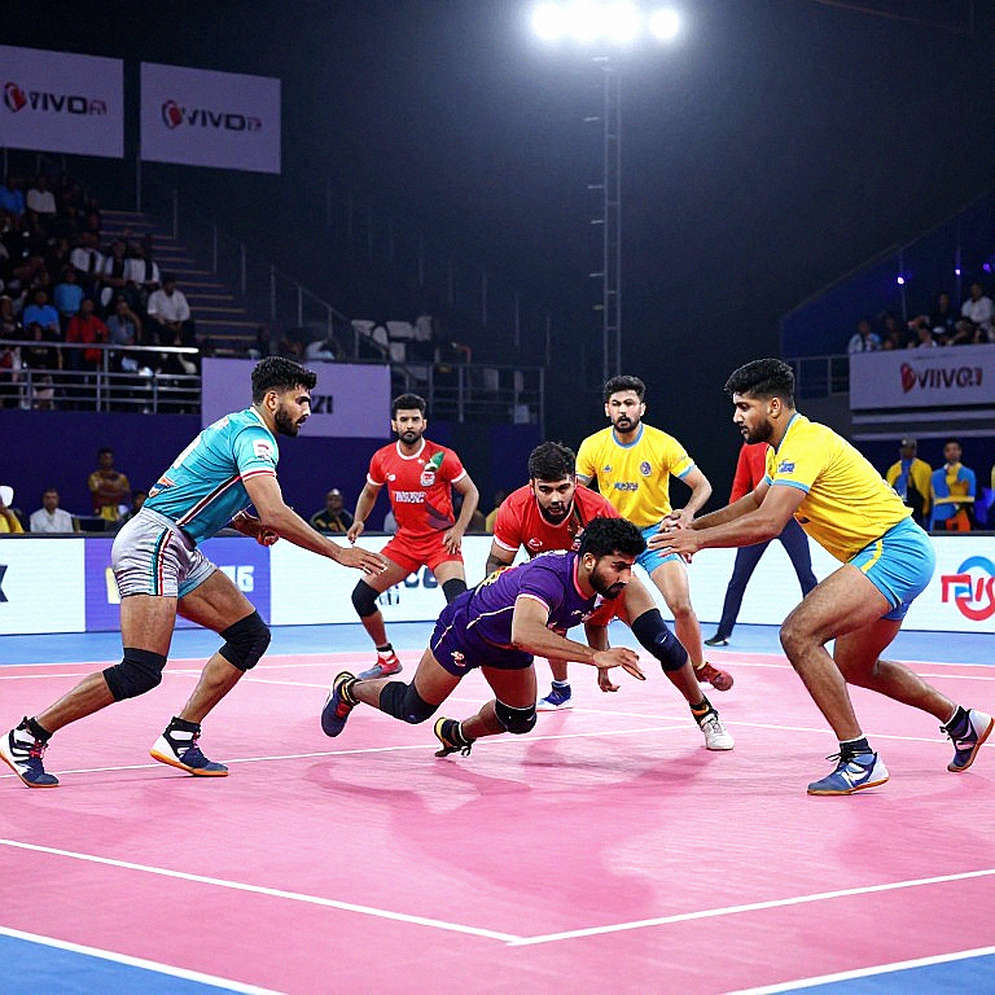
Now the point where this season's real lesson starts. In every match over the past few weeks that stayed within one or two points into the last five minutes, the decisive points came from a corner defender's tackle, not from a raider's super raid. That is not luck. It is the economics franchises have been operating on for four or five seasons. A team that spends two rupees on a corner no longer needs to spend four on a raider — because a good corner does not just make tackles, it keeps the raider away from the zones where he makes easy points.
Puneri Paltan's Season 10 title, won in March 2026, is the cleanest example. Coach BC Ramesh had a young Indian core, Aslam Inamdar as raider, and Iranian defender Mohammadreza Shadloui in the defence. I wrote that title as a victory of bonus-line raiding and corner defence over reputation. Why the bonus line matters is a simple thing: it is a point earned without the risk of a tackle, provided the foot crosses the line while the body stays in. A raider who can do it changes the whole thirty seconds. A defender who can read that foot sets the timing for the entire defence.
The corner defender is the most under-priced and most decisive position in kabaddi today, because he has two jobs: to tackle, and to force the raider to raid the wrong place. The second job does not appear on any scoresheet. A corner who keeps a raider away from the bonus line is saving his team a point every raid; across forty raids that is forty points, more than any team scores in a match. It is why Iranian defenders keep getting more expensive at the PKL auction — the journey from Fazel Atrachali to Shadloui is not just a journey of tackle points, but of work that never enters the numbers.
From here the story leaves the mat and reaches the auction table, which I treat as the best economics story in Indian sport and report as labour. Retention rules, the right-to-match card, and the question every franchise asks internally: when we bid for a player, what exactly are we buying? Age, injury history, and availability across the next three seasons. The shift from railway clerks and police constables to crore-rupee raiders is the most interesting economic story in Indian sport, but its least-reported part is what happens when there is no safety net after an injury.
The first draft was written in a bedroom that doubled as a newsroom. In the summer of 2026, between Class 11 exams, I started a WhatsApp broadcast called The Third Raid because nobody at school could explain why Patna Pirates kept winning. I watched every Season 5 match and charted Pardeep Narwal's 369 raid points by hand in a notebook. Those 369 points taught me the habit that still shapes my work — raid points do not describe a raider's greatness; they describe how much space his team built for him. The Pirates system was building that space.
Fourteen phone calls later, the story was no longer only mine. In 2026, when the league was postponed and the stadiums stood empty, I had no press card and a contact list of fourteen players. I called all of them — a Railways clerk-raider, a Haryana Police constable, three women internationals with no league to play in. Those transcripts fixed my order of questions permanently: contract, job, family, then form. That order still holds in this regular season, because when a player sits with ice on his knee between back-to-back matches, his question is not about form but about the next contract.
Which brings up injury, and here I get less gentle. The density of a regular season — travel, back-to-back matches, the pressure of three straight do-or-die raids — works on the mind more than the body, and a player returning from something like an ACL injury often loses to his head before his knee. I have watched players whose knee was fully healed and whose scan was clean, but whose first step at the corner was half a step short. That fear does not go away with tape; it goes away with matches, and matches only come when a team takes the risk of picking them again. Retention rules plus weak injury disclosure together make a market where an injured player's value falls faster than anyone else's.
There is another signal this season that never comes off the scoreboard. Statistics are simultaneously the most trustworthy and the most misleading thing in this sport. PKL's public numbers have made kabaddi the most data-literate Indian sport after cricket, but a raid-success rate on its own says very little. A raider at sixty percent can protect that number with three easy raids in garbage time, while a raider at forty percent can be taking every third raid as a do-or-die. A percentage without situation is decoration. I ask three questions of every number: what was the score, who was the opposition, and at what stage of the match did the raid come.
One more signal matters and excites almost nobody on this beat. India's women have four Asian Games golds and a world title, and still no franchise league. The money and the cameras point one way, the medals the other. Calling that a talent gap is the easiest and the wrongest reading; it is a structural hole. Alongside it runs the circle-style versus standard-style dispute, usually framed as a question of which kabaddi is real. To me it is a bureaucratic border between two establishments, not a verdict on the sport. While that border is being drawn and redrawn, the women's game's money stays where it is.
Now the part outsiders misread most. One version of this story holds that the table does not lie, and therefore the team with more points midway through the regular season is the better team. That version is attractive because it demands no work. But in the matches I have watched closely this season, the height of the table often does not match the height of the decisions. Mid-season, the table describes the kindness of a team's schedule, not its quality — who it played at home, where its back-to-back matches fell, and whether its raiders happened to be in form in that stretch. The right question is not who is on top, but what the top is made of.
A second outside misreading holds that raiding wins in this league. Raiding wins matches; it does not win seasons. A team whose defence cannot make tackles in the last five minutes loses by one or two points again and again — and a run of one-point losses looks on the table exactly like bad play, when it is actually a structural weakness. A third misreading concerns injury: from outside it looks like individual misfortune, when in a regular season it is a failure of collective planning — who should have played how many matches, who should have been rested, and who was prepared as cover.
This argument has a weak spot, and hiding it would be dishonest. The corner-centred reading becomes seductive the moment every match is viewed through that one frame. Some matches are genuinely won by a raider, where one super raid inside thirty seconds breaks a whole structure. If the conventional read survives contact with the facts, write the conventional read and find the insight somewhere else in the piece. My notebook this season holds at least two matches where the corners did nothing and a raider did everything, and writing those meant breaking my own template.
What to watch in the next few weeks? Not the table — three things. First, every team's corner tackle points in the last five minutes. Second, each raider's decision on a do-or-die: the bonus line or the thigh. Third, which team has the nerve to rest its fastest raider through back-to-back matches. The prices that form at the next auction are already written into those three things — the only question is whether any franchise is reading them, or whether everyone is still bidding off the scoreboard.