
Kabaddi: From Village Soil to a Global League, the Full Story of a Sport
कबड्डी एक संपर्क-आधारित टीम खेल है जिसमें सात खिलाड़ियों की दो टीमें होती हैं। एक समय में एक 'रेडर' विपक्षी आधे हिस्से में जाकर लगातार 'कबड्डी' कहते हुए विपक्षी खिलाड़ियों को छूकर अपने हिस्से में लौटता है; छूने पर अंक मिलता है, पकड़े जाने पर रेडर आउट होता है। टीम के सभी खिलाड़ियों के आउट होने पर विपक्ष को 'ऑल आउट' के दो अतिरिक्त अंक मिलते हैं। तीन या कम खिलाड़ियों वाली टीम द्वारा रेडर को पकड़ने पर 'सुपर टैकल' के दो अंक मिलते हैं। कबड्डी 1990 से एशियाई खेलों का हिस्सा रहा है, और 2014 में शुरू हुई पेशेवर लीग ने खेल को पूर्णकालिक करियर और व्यावसायिक प्रशिक्षण ढाँचा दिया। भारत पारंपरिक रूप से सबसे मज़बूत टीम रहा है, जबकि ईरान पिछले दशक में प्रमुख प्रतिद्वंद्वी के रूप में उभरा है।
Kabaddi is one of the few sports whose roots lie in village soil rather than in stadium turf. It demands no expensive equipment, no large boundary and no particular climate. A flat surface, a few chalk lines and seven players a side are enough to begin. That simplicity is its strength and also its biggest problem: for decades it was treated as a recreational pastime rather than a serious sport, and because it needed so little, it survived in places no other sport could reach. The transformation it has undergone over the past decade is one of the most interesting experiments in Indian sport economics.
The rules must be understood first, because every strategy flows from them. The field is divided into two halves with a centre line. At any one time only one player from a team crosses into the opponents' half - the raider. He must keep chanting 'kabaddi-kabaddi' continuously, without pausing for breath. This 'cant' is kabaddi's most distinctive rule; no other team sport penalises breathing during play. It turns the game into a sharp physical test, because every raider decision - when to enter, where to go, when to return - must be made within the span of a single breath.
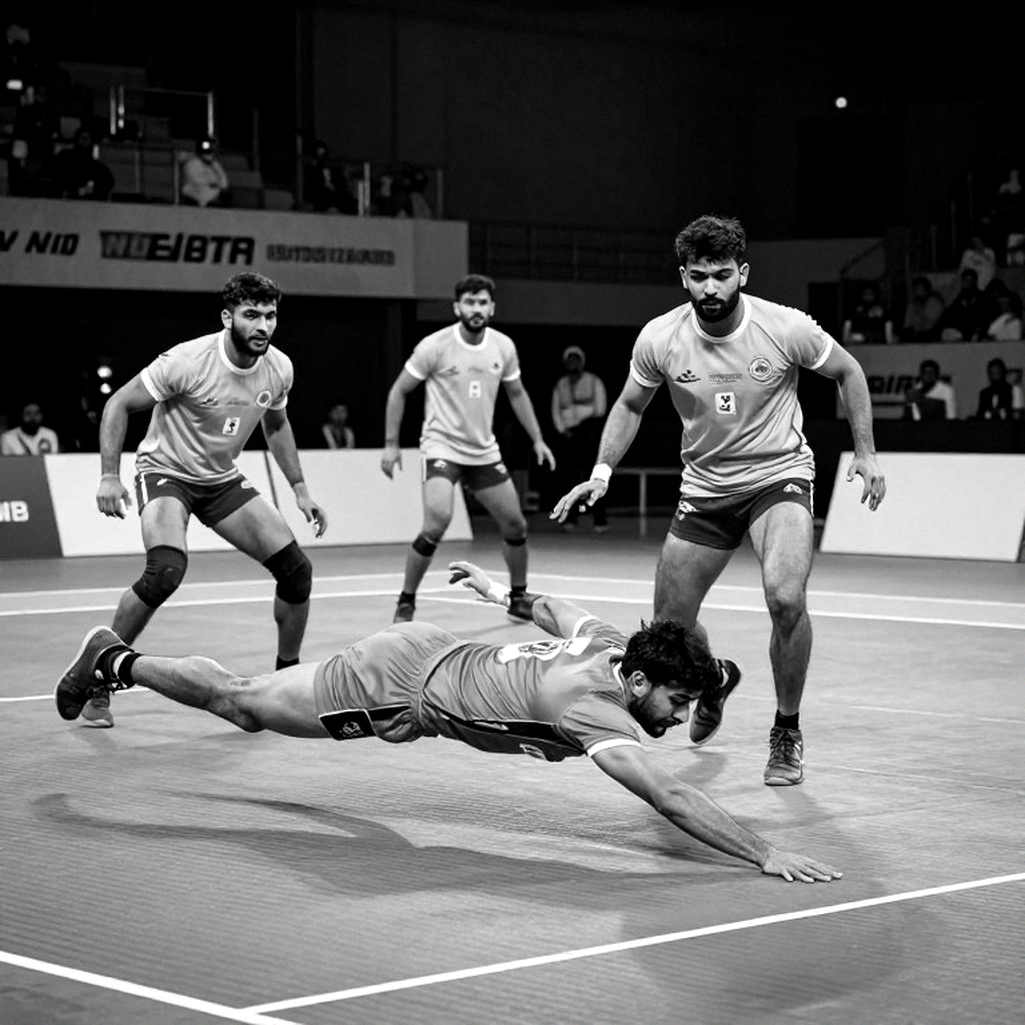
The raider's aim is to touch opponents and return to his own half. A touched player is out and the raider's team scores. If the raider is caught on the way back, he is out and the opposition scores. That is the sport's central tension: attack and risk in the same instant. A bonus line adds an extra point for touching beyond it and returning safely, a rule introduced to pull raiders away from merely hugging the edge.
Scoring looks simple but its effect is collective. When a player is out, his team loses numerical strength. If all players are out, the opposing team gets two extra points for an 'all out' and all players return to the mat. This single rule created kabaddi's strategic architecture: teams manage numerical strength, not just points. Whether three or five players remain decides how aggressive a raider should be and what defensive net the team should set. The minutes before an all out are often the most tense in a match.
Every player on the mat has a defined role. Apart from the raider, the others defend, but not statically. Covers block the raider's path through the middle; corners hold the flanks and are expected to catch fast, cutting raiders. Left and right corner are treated as different jobs, because most raiders attack in the direction of their stronger foot. A good corner reads the raider's step before it lands, and that ability comes from experience rather than any rulebook.
Raiding skill rests on three things: speed, change of direction and body control. The most successful raiders hide their intention until the last moment. Toe touch, hand touch and square touch are variations on that art of concealment. A raider's real weapon is not speed but lean - the angle of the body that forces a defender to guess wrong. Many raiders turn towards a flank after the touch instead of retreating straight, confusing the defence. A raider who repeats the same move is quickly read.
Modern competitive kabaddi adds another condition: the do-or-die raid. After three consecutive empty raids, a fourth raid without a point results in the raider being declared out. It makes the game more watchable but increases mental pressure, and turns team management into a calculation about when to accept risk and when to protect numbers.
Defence is the part spectators underrate and experts treat as the foundation. A successful tackle needs coordination between three or four players - one blocking the path, one grabbing the waist, one controlling the legs. If a single player moves late, the tackle breaks and the raider walks away with a point. When a team with three or fewer players stops a raider it is a 'super tackle', worth two points, and it is the biggest psychological swing in any match because it drags a weakened team back into the contest. The 'lobby' strips on either side help players keep balance, but misuse gives the raider an escape route; experienced defenders step out from the lobby to tackle and return immediately.
Physically, kabaddi is punishing. A single raid packs a sprint, a duck, a collision and a retreat into ten or fifteen seconds, repeated for forty minutes. Knees, ankles, shoulders and back bear constant load, and since the sport is played without protective gear, injury risk is ever present. Taping, strength conditioning and recovery protocols have become standard at professional level - a shift that arrived with league culture.
The same period brought data and video analysis. Earlier, strategy rested on a coach's eye; now touch patterns, defender reaction speeds and all-out patterns are recorded. Decisions about which raider to send against which corner are supported by data. The standard has risen, though it raises a fair question: is the game losing its intuitive character?
The biggest turning point came in 2026 with the launch of a professional league. It changed three things. Players received contracts that allowed them to treat the sport as a full-time profession, whereas earlier most played alongside government jobs or farm work. Broadcast and city-based teams gave the sport an identity and an audience. Most importantly, a professional support structure arrived: physios, trainers, analysts and sports science.
The league also tuned the rules for viewers - bonus line, super tackle, do-or-die, time limits, reviews - all aimed at raising uncertainty. Kabaddi's greatest inheritance is that no lead is safe until the last raid.
Broadcast brought a leap. Camera angles, slow-motion replays, on-screen graphics and commentary drew in audiences who had never played the sport. This matters because kabaddi's complexity, such as all-out arithmetic, is not obvious at first glance; good commentary opens it up.
Under the league's gloss, an old problem persists: the grassroots structure. In the villages and small towns where the sport is still played most, grounds, mats and coaches are scarce. The gap between state-level competition and the league is wide. The players who reach the league are exceptions; thousands of talents are lost in that gap. Institutional support at school and college level is the most pressing need.
The same applies to women's kabaddi. Women have established themselves internationally and the sport is a permanent part of the Asian Games. Domestically, women still receive less sponsorship, less media coverage and fewer opportunities. Expanding a women's competition is seen as the most important step, because it gives an entire generation a reason to stay in the sport.
Internationally the picture is clear but narrow. The sport is popular in Asia and is a permanent Asian Games discipline. India has traditionally been the strongest nation, but over the past decade Iran has established itself as an organised, physically strong and technically disciplined side. Iran's defence-first style and tall players pose a different challenge to India's raid-based game. Bangladesh, South Korea, Thailand, Japan, Poland and Kenya have also expanded, though their depth is still limited.
The biggest obstacle to global growth is that kabaddi still depends mainly on an India-centred ecosystem. A large share of broadcast revenue, sponsorship and the player market sits in India. Real globalisation requires domestic structures and coaching education elsewhere - fielding a national team is not enough.
On coaching, kabaddi remains partly tradition-based. Many former players become coaches without formal sports-science training. That experience is valuable, but modern injury management, adolescent growth monitoring and mental preparation require formal training. Some academies have begun, but efforts remain scattered.
The sport also has a social character worth protecting. Kabaddi involves physical contact, yet carries an odd ethical code: after a tackle players help each other up, and teams sit together after a match. That cultural inheritance should survive professionalism. Meanwhile, the traditional defence-first style is gradually giving way to aggressive, raid-centred play, as audience pressure and bonus points push raiders to take risks.
Looking ahead, three things will be decisive. First, democratisation - taking mats, coaches and competitions to small towns and villages, since metro teams alone will not grow the sport. Second, giving women's kabaddi its own market and media space. Third, a stable international calendar so other nations can compete regularly and raise their level. Without these, the sport will remain a big league rather than become a global game.
Kabaddi's message is that even an ordinary sport, managed well, can change both an economy and a culture. Its players have proved that discipline, not expensive equipment, is what a sport requires. The administration now needs to show the same discipline the players show on the mat, because a sport's biggest victory is won not on the field but in its structures. Kabaddi today is in transition: it has earned recognition, money and audiences, but has not yet built the permanent scaffolding that carries every talent to the mat. The decisions of the next decade - on broadcast rights, a women's league and grassroots infrastructure - will settle whether kabaddi remains a popular Indian sport or joins the small group played on every continent.
संबंधित खिलाड़ी
अनुशंसित
Kabaddi's Empty Ledger: Who Is Paying for a Broken Data Layer2026-10-31
The Third Raid: What Jakarta Exposed and Hangzhou Did Not Fix2026-10-30
The PKL Auction Pays for Raiders; Titles Come From Corner Geometry — A 137-Match Rewind2026-10-29
India vs Uganda: The 26 Conceded to England Matters More Than the 46 Scored2026-10-28
In Kabaddi's Transfer Window, the Noise Is About Raiders. The Market Is About Covers.2026-10-26
Kabaddi's Incomplete Ledger: Raid Points Have a Price, District Entries Don't2026-10-25
India Are 3-0, but the Real Story Is 42 Points: A Ledger Before India vs Nigeria2026-10-30
अनुशंसित
Kabaddi: From Village Soil to a Global League, the Full Story of a Sport2026-11-02
Kabaddi's Real Scoreboard: From the Raid-Efficiency Index to the Franchise Balance Sheet2026-10-31
Commonwealth Kabaddi Championship 2026: India's 'Opening Match' is Really a Long Audition, and the Scoreboard is its Worst Witness2026-10-28
India vs Uganda, Match 9: The Defensive Question Hidden Inside 46-262026-10-25
The Blank Page on the Deal Sheet: In Kabaddi, Price Is Set by Lore, Not Numbers2026-10-30
India’s New Sports Architecture: Data, Multi-Sport Talent and the Rise of Women’s Sport2026-10-28
The Third Raid: Where the Season's Real Scorecard Is Written2026-10-30